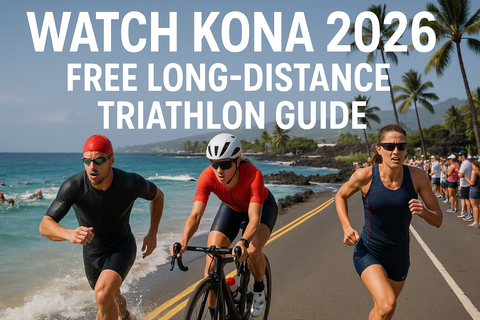

Georgia Taylor-Brown Rewrites the Record at IRONMAN 70.3 Bahrain
A tactical masterclass and a historic 3:51:19 performance that resets the benchmark for women's middle-distance triathlon.
Georgia Taylor-Brown didn't just defend her IRONMAN 70.3 Bahrain title – she obliterated the world record by nearly two minutes, clocking an unprecedented 3:51:19 that has rewritten the history books for women's middle-distance triathlon. In a race that showcased tactical brilliance and raw speed, both Taylor-Brown and partner Vincent Luis executed perfect strategies to claim victories that could define their seasons.
The IRONMAN 70.3 distance – comprising a 1.9km swim, 90km bike, and 21.1km run – represents the sweet spot of triathlon racing. It's long enough to demand strategic pacing and endurance, yet short enough for athletes to sustain near-threshold efforts throughout. For elite athletes, Bahrain has emerged as the perfect season-ending venue, offering fast courses and favorable conditions that bring out peak performances.
The Record That Rewrote History
Taylor-Brown's stunning 3:51:19 didn't just edge past the previous world best – it demolished it. The previous benchmark belonged to American Taylor Knibb, who clocked 3:53:02 at the 2023 IRONMAN 70.3 World Championship in Finland. That time had itself been just one second faster than German Laura Philipp's 3:53:02 from 2022 Dubai, showing how fiercely contested the record had become at the elite level.
What made Taylor-Brown's performance so extraordinary wasn't just the nearly two-minute improvement over the previous best. The British star achieved this time while racing tactically rather than going all-out from the start. Her splits tell the story of a perfectly executed race:
- Swim: 25:17 – A competitive but controlled effort that kept her in touch with the leaders
- Bike: 2:06:48 – Where the foundations for victory were laid through smart positioning
- Run: 1:16:11 – A masterclass in middle-distance running that sealed both victory and the record
The technical brilliance of these splits becomes clear when compared to her previous 70.3 performances. Taylor-Brown has consistently shown the ability to negative split her races, getting stronger as the distance progresses – a hallmark of athletes who understand energy management at the highest level.
Race Tactics: How GTB Executed the Perfect Strategy
The Patient Swim Approach
In a field of just four women, Taylor-Brown resisted any temptation to establish early dominance. Instead, she employed a patient approach that would prove crucial later in the race. Swimming alongside India Lee and Australia's Natalie Van Coevorden, the trio effectively became the race after distancing American Rachael Tatko by more than five minutes.
This conservative start demonstrated Taylor-Brown's racing maturity. Rather than expending energy to establish a lead she couldn't necessarily maintain, she conserved precious resources for the disciplines where she could make the most decisive moves. For swimmers looking to improve their efficiency, investing in quality anti-fog swim goggles can make a significant difference in open water conditions.
The Bike Leg Masterclass
The 90km bike leg saw the front three remain locked together throughout, with Lee marginally ahead entering T2, followed closely by Van Coevorden and Taylor-Brown. This tight formation racing required constant tactical awareness – knowing when to cover moves, when to contribute to the pace, and when to position for the crucial transition to the run.
Van Coevorden's quick transition put her first onto the run course, but Taylor-Brown's experience showed as she quickly established her rhythm and began to assert control over the race. Elite athletes often rely on heart rate monitors to maintain optimal pacing during critical race segments.
The Decisive Run Performance
By the end of the first 5km lap, Taylor-Brown had opened a commanding 32-second lead over Van Coevorden, with Lee already over a minute behind. This early move on the run demonstrated her confidence in her running form and her understanding of when to make race-winning moves.
The consistency of her pacing proved crucial as she extended her advantage on laps two and three. Even when Van Coevorden managed to close slightly on the fourth and final loop, Taylor-Brown maintained more than a two-minute cushion at the finish line.
Vincent Luis: Proving Class is Permanent
While Taylor-Brown was rewriting the record books, her partner Vincent Luis was crafting his own masterpiece. The French legend has faced injury challenges throughout 2025, making his road back to form all the more impressive. Recent performances – including a top 10 at the 70.3 World Championship and a top five at the chaotic T100 Dubai – hinted at his return to peak form.
Strategic Race Execution
Luis employed similar tactical discipline in the men's race. Swimming in a front group of four alongside Chase McQueen (USA), Portugal's Vasco Vilaca (making his middle-distance debut), and Germany's Valentin Wernz, he avoided early fireworks that could have compromised his race.
The Dominant Run Display
Luis opened a 24-second gap on McQueen after just the first 5km lap, then systematically extended his advantage. By halfway, he led by over a minute, with Vilaca having moved into second place. The pattern continued through lap three, with Luis ultimately crossing the finish line in 3:29:08 – a full three minutes faster than his 2024 winning time.
The performance marked Luis's first victory of the season and provided perfect momentum heading into his potential penultimate season. At 35, the French star has hinted that 2026 could be his final year before retirement, making performances like this all the more precious.
The Bahrain Factor: Why This Course Produces Fast Times
Optimal Course Design
The flat, fast bike course allows athletes to maintain high speeds without the energy-sapping climbs found on hillier venues. Combined with typically favorable weather conditions, these factors create an environment where athletes can sustain near-threshold efforts for extended periods.
The smaller elite fields also play a role in fast times. With fewer competitors creating tactical complications, athletes can focus purely on optimal pacing rather than reactive racing. This was evident in both the men's and women's races, where the front groups remained small and tactical throughout.
Setting New Performance Benchmarks
Both winning times significantly improved on the 2024 performances, with all bike splits notably faster than the previous year. This suggests that course conditions and preparation were optimal for fast racing. For age-group athletes, these elite performances provide new benchmarks for what's possible under ideal conditions.
What This Means for the Sport
Taylor-Brown's world record represents more than just a fast time – it signals a new ceiling for women's middle-distance performance. Her 3:51:19 brings women's 70.3 times tantalizingly close to elite men's performances from just a few years ago, highlighting the rapid evolution of the sport.
The Couple Dynamic
The unique situation of both partners winning major races on the same day showcases an intriguing dynamic in professional triathlon. Training together while maintaining individual focus requires careful balance, but the results suggest that shared goals and mutual support can enhance rather than hinder performance.
Their preparation for these races likely benefited from training partnerships that pushed both athletes to higher levels while providing the motivation that comes from shared objectives.
Looking Toward Qatar
Both athletes will now carry significant momentum into next week's T100 Grand Final in Qatar. Taylor-Brown's record-breaking form and Luis's return to winning ways set up what could be spectacular season-ending performances in the Middle East.
The timing couldn't be better, with both athletes peaking at precisely the right moment for the year's most lucrative race. Their Bahrain victories provide not just physical confirmation of their form but the mental confidence that comes from executing perfect race strategies under pressure.
Lessons for Age-Group Athletes
The tactical discipline displayed by both champions offers valuable insights for athletes at all levels:
- Energy Management: Both winners showed remarkable restraint in the early stages, conserving energy for when it mattered most.
- Consistent Pacing: Rather than dramatic surges and fades, both maintained steady pressure throughout their winning moves.
- Strategic Positioning: Smart positioning during the swim and bike phases set up their decisive run performances.
These principles translate directly to age-group racing, where tactical awareness can often compensate for pure speed. Proper nutrition and hydration are also critical – consider using electrolyte supplements to maintain performance during long training sessions and races.
The New Standard
Taylor-Brown's 3:51:19 doesn't just represent a new world record – it establishes a new psychological barrier for women's middle-distance racing. Breaking the 3:52 mark seemed unthinkable just a few years ago; now it appears merely the first step toward even faster times.
As both athletes prepare for the T100 Grand Final, they carry with them the confidence that comes from perfect preparation meeting optimal opportunity. Their Bahrain triumphs prove that in triathlon, as in life, the best performances often come when tactical brilliance meets physical preparation and mental fortitude.
The record books have been rewritten, but perhaps more importantly, the template for achieving such performances has been laid out for the next generation to follow. For those inspired to pursue their own triathlon goals, investing in quality gear like a GPS running watch can help track progress and optimize training.
Find the perfect race day essentials at TriLaunchpad — your triathlon journey starts here. Shop all collections →