Jonny Brownlee's Epic Weekend: 10 Triathlons at Blenheim Palace
Olympic legend. Record-breaker. Proud new dad. This weekend, Jonny Brownlee redefined what athletic success really looks like.
Imagine finishing your sixth triathlon of the day — legs burning, wind whipping sideways across a UNESCO World Heritage estate — and realizing you still have four more to go tomorrow. For most of us, that thought alone would be enough to hang up the wetsuit for good.
For Jonny Brownlee, it was the moment that revealed something far more powerful than Olympic medals ever had.
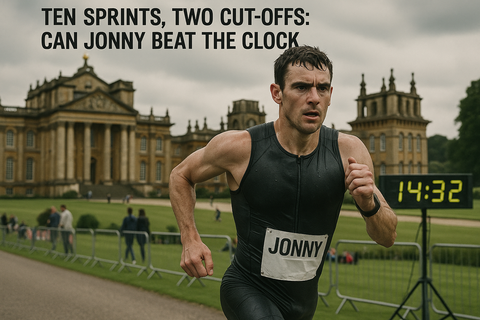
On June 6–7, 2026, at Supertri Blenheim Palace in Oxfordshire, the three-time Olympic medallist became the first athlete in history to complete all 10 races in the event's Weekend Warrior challenge — 10 full sprint-distance triathlons across a single 48-hour window. He crossed the final finish line at 3:18pm Sunday, seven-month-old son Freddie in his arms, wife Fi beaming beside him.
This story is about more than athletic endurance. It's about how perspective transforms when you become a parent, why the hardest challenges aren't always the longest ones, and what one of Britain's greatest triathletes can teach every age-grouper — from Leeds to Lagos to Guadalajara — about redefining success.
What Is the Weekend Warrior Challenge?
Before we get into the epic details, let's clarify what Brownlee actually did — because this isn't your standard endurance event.
A sprint-distance triathlon consists of:
- 🏊 750m open-water swim
- 🚴 20km bike ride
- 🏃 5km run
The Weekend Warrior format asks participants to repeat this distance as many times as possible across two days, with fixed daily swim cut-off times creating the real pressure. Miss the cut-off, and your race day is done — regardless of how much energy you have left.
- Saturday cut-off: 15:40
- Sunday cut-off: 14:20
That constraint — not the sheer volume of distance — is what makes the challenge genuinely diabolical.
The Numbers Behind the Record
Let's let the data do the talking for a moment:
| Metric | Total |
|---|---|
| 🏊 Swimming | 7.5km |
| 🚴 Cycling | 200km |
| 🏃 Running | 50km |
| ⏱️ Total race time | 12 hours, 24 minutes, 25 seconds |
| 📅 Saturday | 6 triathlons (finished 4:45pm) |
| 📅 Sunday | 4 triathlons (finished 3:18pm) |
| ⚡ Final swim start | 2:07pm — just 12 minutes before cut-off |
To keep 10 races alive across two days, Brownlee needed to maintain a turnaround of roughly 75 minutes between each triathlon — that's race time, transition, travel back to the swim start, and joining the next wave. For 10 consecutive efforts. On legs that never fully recovered.
That's not endurance. That's logistics under fire.
Saturday's Strategy: Building the Cushion
Brownlee set off at 9:09am Saturday with the calm, metronomic precision you'd expect from someone who's raced at three Olympic Games.
His early triathlons landed just under 68 minutes each — fast enough to bank comfortable margin against the 15:40 cut-off, but controlled enough to preserve something in the tank. Think of it like a runner who goes out at marathon pace to save the real effort for the back half: building a buffer is the strategy, not a sign of holding back.
As Saturday wore on and the sixth race hove into view, the wind picked up and fatigue started to show. Race 5 crept to 1:12:27; Race 6 slipped to 1:17:42. But the early cushion had done its job. With six races in the bank, Brownlee eased the final lap and closed day one at 4:45pm.
“Yesterday was the biggest challenge and mentally when I was two or three in and the end felt so far away. The wind was coming in sideways and I wasn’t sure I could do it.” — Jonny Brownlee
Sunday's Execution: Raising the Pace
Sunday presented a tighter window. Only four more races were available — but on legs that had already raced six times — and the final swim needed to be away before 14:20. There was no room for a slow start.
Brownlee had predicted he'd need to come out sharper on day two. He delivered. Race 7 clocked 1:05:21 — his fastest triathlon of the entire weekend — and he maintained that elevated pace through Races 8 and 9 as well.
The tenth and final swim cleared the cut-off at 2:07pm, with 12 minutes to spare. He ran the last lap home to a record finish. Ten races. Done.
Race-by-Race Breakdown
Here's how each triathlon unfolded across the weekend:
| Race | Time | Transition | Notes |
|---|---|---|---|
| 1 | 1:06:57 | 7:22 | Strong, measured start |
| 2 | 1:08:47 | 6:43 | Finding rhythm |
| 3 | 1:07:57 | 7:10 | Consistent pacing |
| 4 | 1:07:44 | 6:17 | Controlled effort |
| 5 | 1:12:27 | 6:28 | Fatigue beginning to show |
| 6 | 1:17:42 | — | End of day one; cushion used |
| 7 | 1:05:21 | 5:36 | Fastest race of weekend |
| 8 | 1:06:47 | 6:23 | Sharp Sunday pace |
| 9 | 1:07:09 | 6:19 | Holding form |
| 10 | 1:11:16 | — | Final push to history |
Total: 12 hours, 24 minutes, 25 seconds
Notice what the data reveals: transitions actually got faster on Sunday, despite heavier fatigue. That's not accident — that's an athlete who knows how to manage his mind as much as his body.
The Mental Game: Where the Real Race Happened
Here's the thing about Jonny Brownlee's Weekend Warrior record that no stat can fully capture: his legs weren't the limiting factor. His mind was.
“My legs actually feel quite good. Yesterday was the biggest challenge and mentally when I was two or three in and the end felt so far away.” — Jonny Brownlee
Read that again. After six sprint triathlons, his legs felt fine. The wind, the repetition, the psychological weight of knowing you're barely a quarter of the way through — that's what nearly broke him. And that lesson applies to every triathlete, whether you're racing your first sprint or your tenth.
This is what sports psychologists call the mid-challenge valley: that dangerous zone where the start feels distant and the finish feels impossibly far. Elite athletes don't avoid it — they have strategies to cross it.
For Brownlee, that strategy had a name: Fi and Freddie.
From Olympic Champion to Proud Dad: The Perspective Shift
The most remarkable thing about this weekend wasn't the 200km of cycling or the 7.5km of swimming. It was a quote that no one would have predicted from a man who once told himself that every second counts and that talking to people during a race was a distraction.
“This challenge is what sport is all about. If you had asked me ten years ago I would have said ‘it’s all about every second counts, am I missing training by being here, I can’t talk to people because I need to focus on my race’. Now I realise sport is more than that.” — Jonny Brownlee
When Saturday's wind and fatigue threatened to derail everything, Brownlee didn't dig into some technical race strategy. He thought about his family.
“When I was getting a bit tired on Saturday I thought all I had to do was get to the finish line and I could give Fi and Freddie a big cuddle and it’s all ok.” — Jonny Brownlee
Emotional anchors aren't weakness — they're fuel. Research in sports psychology consistently shows that purpose-driven motivation (racing for something beyond yourself) sustains performance far longer than ego-driven goals. Brownlee discovered this not in a lab, but across 48 brutal hours at Blenheim Palace.
Redefining Success: A New Model for Elite Athletes
Elite athletes often struggle with identity after their competitive peak. The training schedules vanish, the podiums disappear, and with them can go the sense of purpose that defined a decade or more of life.
Brownlee's Weekend Warrior attempt charts a different path — one that many triathletes between the ages of 25 and 45 will recognize, whether they're former competitors or weekend warriors themselves.
“Your perspective changes in life. When I raced here in 2012 I would never have thought I would say this, but there are more important things in life than sport.” — Jonny Brownlee
This isn't retirement talking. This is evolution. Brownlee raced alongside age-groupers all weekend — drawing inspiration from their determination, celebrating their goals, sharing in the collective energy of a mass-participation event. That's a very different experience from the Olympic athlete who needed tunnel focus to compete.
The model he's demonstrating: participation over dominance. Community over isolation. Meaning over medals.
For any triathlete — from Mexico City to Madrid, from São Paulo to Sydney — who has wondered whether their best days are behind them, Brownlee's weekend offers a clear answer: your relationship with sport doesn't end when the podiums do. It just changes shape.
Why Blenheim Palace Made This Moment Richer
The setting wasn't incidental. Blenheim Palace — the UNESCO World Heritage Site in Oxfordshire, birthplace of Sir Winston Churchill — has hosted triathlon for over two decades. It's arguably the most storied mass-participation triathlon venue in the UK.
And for Jonny Brownlee specifically, it carries a very particular kind of weight.
In 2012, he and his brother Alistair raced here as a warm-up ahead of the London Olympic Games — and famously crossed the finish line in a dead heat for first place. Fourteen years later, the same course witnessed a very different kind of history: not a fraternal tie, but a solo record carrying a baby across the line.
2026 marks the first year Supertri has operated the event. It remains the biggest triathlon in the UK and one of the five largest in the world by participant numbers, with entry formats ranging from SuperSprint and Sprint Relay to the Weekend Warrior and a professional Pro Series race. Thousands of amateur athletes shared the course with Brownlee all weekend — and that, he made clear, was the whole point.
5 Lessons Every Triathlete Can Take From This Weekend
You don't need to be an Olympic medallist to apply what Brownlee demonstrated across those 48 hours. Here's what the record reveals about endurance, pacing, and what it actually means to compete.
1. Build a buffer early, not a PR
Brownlee's early races averaged just under 68 minutes — deliberately conservative. He wasn't sandbagging; he was buying insurance. In any multi-effort challenge (or even a single long race), resisting the urge to go hard early is what enables a strong finish. Proper pacing strategy is essential for sustained performance.
2. Transitions are part of the race
Look at Sunday's transition times — they actually shortened compared to Saturday. In a race where 75 minutes separated each start, six minutes in transition matters. For age-groupers doing a single sprint, slick transitions can make all the difference between a personal best and a near miss.
3. Find your emotional anchor
Brownlee's family didn't just cheer from the sidelines — they were his strategic fuel. Before your next race, identify the person, purpose, or moment you're racing toward. Write it down. Tape it to your handlebars if you have to. When the mid-challenge valley hits, that anchor is what pulls you through.
4. Community amplifies performance
Racing alongside thousands of age-groupers didn't slow Brownlee down — it energized him. Mass-participation events carry a collective momentum that solo training never replicates. If you've been racing small, consider going bigger. The crowd doesn't just cheer for the elites.
5. Redefine what winning means — regularly
Brownlee's 2012 self optimized for podiums. His 2026 self optimized for meaning. Both versions won. The athletes who stay in this sport for decades are the ones who keep asking: what does success look like right now? The answer changes. That's not failure — that's wisdom.
Frequently Asked Questions
What record did Jonny Brownlee break at the Supertri Blenheim Palace?
Jonny Brownlee broke the Weekend Warrior record by completing 10 sprint-distance triathlons in a single weekend at the Supertri Blenheim Palace, making him the first athlete to achieve this feat.
What is the Sprint-distance triathlon distance that Jonny Brownlee completed?
Each sprint-distance triathlon consists of a 750m swim, a 20km bike ride, and a 5km run.
What inspired Jonny Brownlee during the race?
Jonny Brownlee was inspired by the presence of his wife and baby son, Freddie, who provided him motivation throughout the weekend.
How did Jonny Brownlee manage the race times during the event?
Brownlee had to maintain a turnaround time of roughly 75 minutes for each race to ensure he could start the next swim before cut-off times while racing up to 10 times over the weekend.
What is Supertri Blenheim Palace known for?
Supertri Blenheim Palace is the biggest triathlon in the UK and one of the largest in the world, featuring various race formats such as SuperSprint, Sprint, Sprint Relay, and the Weekend Warrior, among others.
Source: 220triathlon.com — Jonny Brownlee breaks Blenheim Weekend Warrior record